
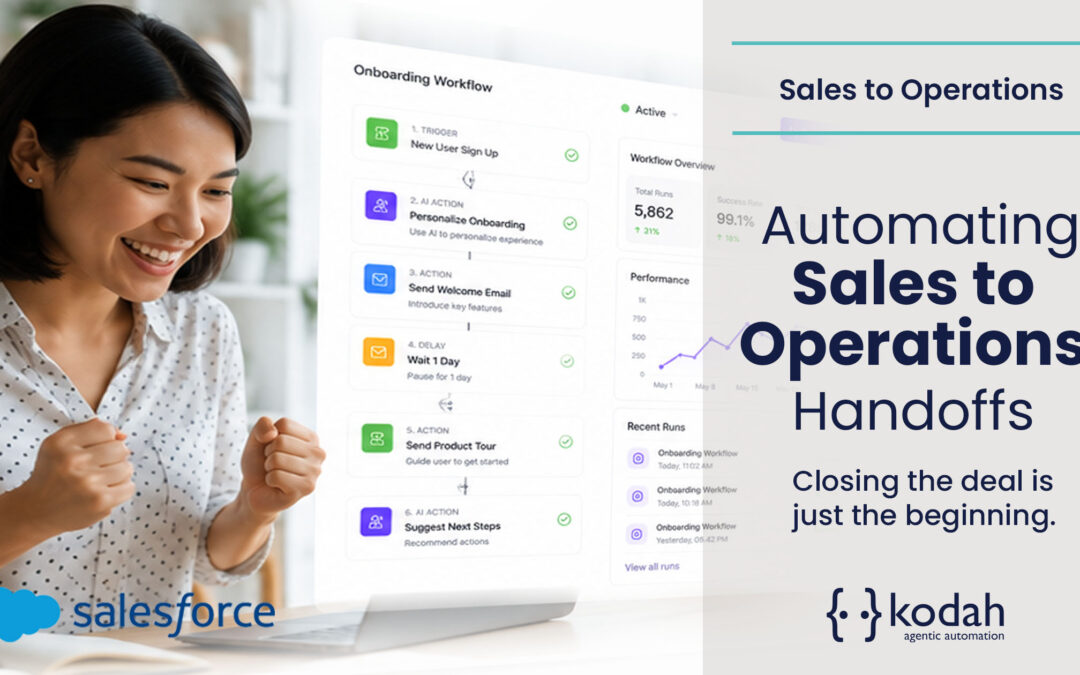
Salesforce Closed Won ClickUp automation sounds straightforward. A deal closes, a project gets created, and work begins.
But for many growing organisations, that is exactly where problems start.
The challenge is not moving information from one system to another. The challenge is making sure the right information moves, at the right time, to the right people.
For CSOs, effective sales to operations handoffs are about protecting three things at once:
- Revenue accuracy
- Delivery confidence
- Customer experience
If the handoff breaks, the impact is felt far beyond operations.
The real problem: everyone has a different version of the deal
Most CSOs have seen this happen.
A sales team celebrates a major Closed Won deal. Operations receives a short email with a few notes. Finance discovers the commercial details do not match what is sitting in the CRM.
Everyone is working on the same customer, but they are not working from the same reality.
That disconnect creates problems quickly:
- Delivery teams start projects without the full customer context
- Account managers spend time clarifying promises that were already made
- Forecasts look healthy until delivery challenges affect revenue
- Customers repeat information they already shared during sales conversations
The underlying issue is not just missing data. It is that sales and operations are often running different processes.
Salesforce reflects the commercial journey. ClickUp reflects execution. The gap between the two is where manual updates, assumptions and missed details start to appear.
As businesses scale, that gap becomes harder to manage. More deals move faster. More teams become involved. More information gets lost between conversations.
The handoff is not a single event
Many companies think the handoff happens when an opportunity changes to Closed Won.
That is only the trigger.
A successful handoff involves understanding what was sold, translating it into operational requirements, assigning the right resources and creating a shared plan.
A stronger process asks:
What exactly was promised?
Operations should not need a meeting with the salesperson just to understand the basics of the deal.
How should this type of work be delivered?
A recurring service, a large implementation and a simple project should not all follow the same path.
What does success look like?
Sales, operations and finance should know what milestones matter and how progress will be measured.
This is where many automation projects fall short. They automate the movement of information but not the decision making behind it.
The goal is not just to create more tasks. It is to create a more intelligent connection between teams.
The Kodah approach: creating one operational story
Kodah views Revenue Operations as the connection point between sales, delivery and finance.
The objective is simple: create one shared view of what has been sold, what needs to happen next and where risks might appear.
A strong handoff process focuses on three areas.
- Make the deal understandable
A Closed Won opportunity should tell a complete story.
That means capturing more than a deal value and customer name. Operations needs context:
- What problem is the customer solving?
- What outcomes were promised?
- What deadlines or dependencies exist?
- Are there risks hidden in meeting notes or emails?
For example, imagine a sales executive closes a complex implementation deal after several months of discussions. The CRM shows the contract value and product package, but the operational team has no visibility into the custom requirements the customer discussed during negotiations.
Automation cannot solve that missing context. The process needs to capture it first.
- Turn deals into delivery blueprints
The next step is creating repeatable delivery patterns.
Instead of starting every project from scratch, organisations can build templates around common scenarios:
- A fixed scope implementation with discovery, configuration, testing and launch phases
- A multi department transformation project requiring different owners and approval points
- A managed service engagement with recurring reporting, support and review cycles
The automation then selects the right structure based on the deal.
The team still makes decisions. The system simply removes the unnecessary repetition.
- Keep revenue and delivery connected
A handoff should not end when the ClickUp project is created.
Salesforce should continue reflecting what is happening after the sale.
For example:
- Delivery milestones can improve forecasting accuracy
- Scope changes can trigger commercial reviews
- Project risks can inform account management conversations
Without this connection, businesses simply move disconnected information into another platform.
How Salesforce, ClickUp and Claude work together
A practical RevOps setup combines three different capabilities.
Salesforce provides the commercial picture.
ClickUp manages execution.
Claude acts as a reasoning layer that helps interpret information, identify patterns and recommend next steps.
Here is what that could look like.
Step 1: Closed Won becomes an intelligent trigger
When an opportunity moves to Closed Won in Salesforce, the automation does not immediately create dozens of tasks.
Instead, it reviews the context.
Claude can analyse:
- Opportunity information
- Customer history
- Products or services purchased
- Sales notes and requirements
It then creates a summary for operations:
- What was sold
- What matters for delivery
- Potential risks or missing information
The result is a clearer starting point for the delivery team.
Step 2: The right ClickUp structure is created
Once the deal is understood, the system can recommend the appropriate delivery template.
A smaller implementation might create a simple workflow.
A complex enterprise rollout might trigger:
- Multiple project phases
- Different owners across departments
- Key customer checkpoints
- Risk tracking tasks
The automation follows agreed patterns instead of treating every deal the same.
Step 3: Progress flows back into revenue visibility
As delivery moves forward, meaningful updates return to Salesforce.
Examples:
- Discovery completion updates account status
- Delays trigger internal visibility before customers are impacted
- Completed milestones support renewal and expansion conversations
This creates a much clearer connection between the promise made during sales and the value delivered afterwards.
What this looks like in practice
Two situations show where this approach becomes valuable.
A large enterprise customer signs a complex agreement with multiple requirements. Instead of operations spending days reviewing sales notes and chasing context, Claude creates a delivery summary, ClickUp generates the project structure and the team starts with the right information.
Or consider a company closing 50 smaller deals in a month. Without automation, operations receives a flood of new requests. With intelligent workflows, similar deals are grouped, standard templates are applied and unusual cases are flagged for human attention.
The difference is simple. Teams spend less time translating information and more time making decisions.
Where CSOs should start
The biggest mistake is starting with technology before fixing the process.
Before automating anything, ask:
- Can operations understand a deal without speaking to the salesperson?
- Do your most common deal types have clear delivery patterns?
- Are sales, operations and finance looking at the same customer reality?
If the answer is no, start there.
A practical starting point:
Improve Salesforce data quality
Identify the fields that genuinely matter after Closed Won. Make them part of the sales process, not optional admin.
Build a small ClickUp template library
Do not create dozens of workflows. Start with the three or four delivery models your business uses most often.
Introduce AI where judgement matters
Use Claude to summarise, interpret and recommend. Do not simply use AI to push more information through the system.
Automate once the process is trusted
When teams understand the workflow and trust the outputs, automation can handle the repetitive parts with clear rules and human oversight.
The best place to begin is usually smaller than expected. Pick one product line, customer segment or region. Prove the handoff works. Then expand.
Talk through your RevOps handoff
If your sales and operations teams are spending too much time chasing context, the first step is understanding where the disconnect is happening.
A Discovery session can help map how opportunities currently move through your business, where information gets lost and what a practical automation approach could look like.
From there, you can identify the first improvements worth making without trying to automate everything at once.