
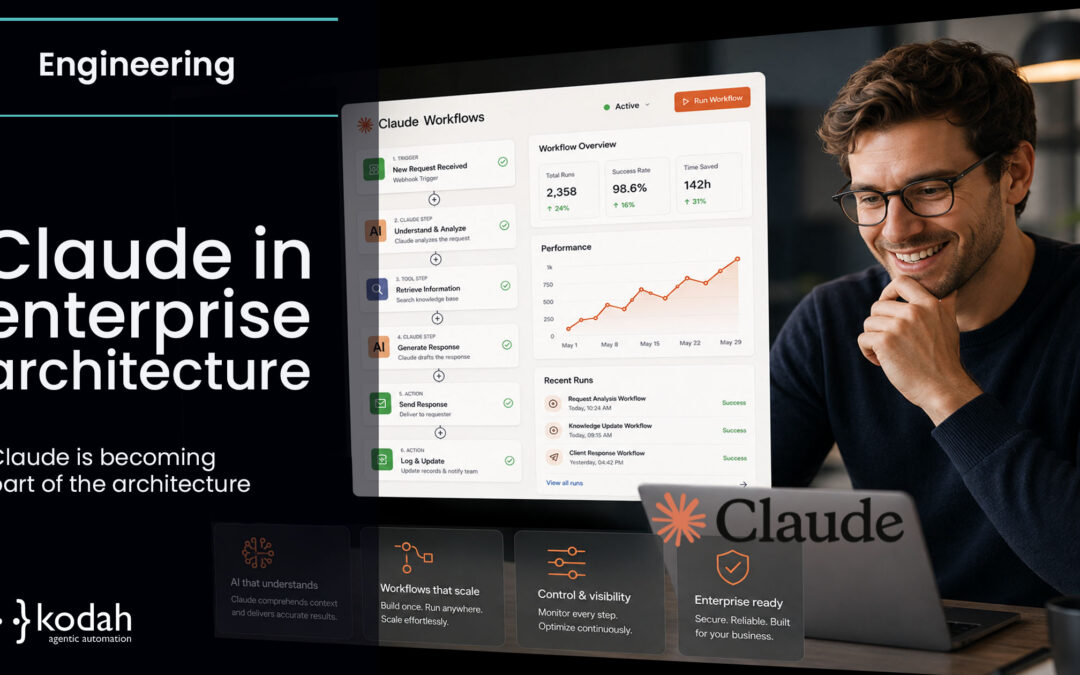
Technology only becomes valuable when it fits naturally into the systems people already rely on every day. That is why we no longer think of Claude as an AI assistant sitting on the edge of the business. We treat it as a core service inside our architecture, working alongside Salesforce, ClickUp, APIs and workflow engines to help real work move safely through production.
Claude is becoming part of the architecture
Early AI projects often start with simple use cases.
Summarise a support ticket.
Draft an email.
Answer a question.
Those are useful starting points, but they are not where the real engineering challenge begins.
Production AI changes the conversation. The moment AI starts supporting customer onboarding, updating operational workflows or coordinating work across systems, it has to behave like any other enterprise service. It needs clear responsibilities, reliable interfaces, strong governance and predictable behaviour.
From our perspective, that means Claude becomes another architectural component with defined contracts rather than another standalone application.
Thinking beyond prompts
A lot of AI conversations focus on prompts, but prompts are only one part of the picture.
The more important question is how reasoning fits into the architecture around it.
In our environment, Claude is responsible for interpreting business context, applying operational logic and helping coordinate work across connected systems. APIs provide access to data, workflow engines execute business processes and operational platforms manage delivery. Claude adds reasoning where human judgement would normally slow the process down.
Think about a sales handover.
A deal closes in Salesforce. Instead of someone manually reviewing notes, creating onboarding tasks and updating multiple systems, Claude interprets the deal context, prepares an onboarding brief and passes structured information into the workflow already waiting inside ClickUp.
Nothing happens outside defined business rules. The reasoning simply removes repetitive work that previously depended on people stitching systems together.
Designing AI as a core service
Treating AI as part of the architecture changes how you design every integration.
Instead of asking whether Claude can access a system, we ask what service should expose that information, what data should be available and what decisions Claude is allowed to support.
That leads to a few consistent engineering principles.
API first architecture
Claude interacts with business systems through well defined APIs rather than direct access to databases or hidden business logic.
This gives engineering teams complete control over the information available and creates stable contracts that can evolve over time without affecting every workflow.
It also makes troubleshooting significantly easier because every interaction follows predictable paths.
Reasoning inside clear boundaries
Reasoning is valuable because business situations are rarely identical, but flexibility should never become unpredictability.
Every workflow defines what information Claude can access, which actions it may recommend and which actions always require approval.
For example, an assistant might recommend the next onboarding milestone based on customer activity, but financial approvals or contract changes remain under human control.
That balance allows AI to accelerate work without introducing unnecessary operational risk.
Observability from day one
We also treat reasoning as something we should be able to observe, not simply trust.
Every interaction can be traced back through the data that informed it, the policies that guided it and the actions that followed.
When something unexpected happens, engineering teams need evidence rather than assumptions.
The same observability that supports incident response also helps improve prompts, policies and workflows over time.
Where this shows up in production
The architectural approach becomes much clearer when you look at everyday workflows.
A support request arrives containing several months of customer history. Instead of someone reading every previous interaction, Claude assembles the relevant context, recommends the next steps and creates any internal work required for specialist teams.
During onboarding, Salesforce provides commercial information while ClickUp manages delivery. Claude connects those two environments by producing structured onboarding briefs, highlighting potential delivery risks and ensuring everyone starts with the same context.
Customer Success follows a similar pattern. Rather than searching through multiple systems before every renewal conversation, teams receive a concise picture of customer health, recent activity and recommended actions based on information already available across the business.
In each example, the surrounding systems continue doing what they were designed to do. AI simply improves the flow of information between them.
Engineering for Production AI
Building Production AI means thinking differently about software.
We spend as much time designing schemas, interfaces and governance as we do designing prompts.
Reliable AI depends on consistent data contracts.
Reliable AI depends on workflows that make sense before intelligence is added.
Reliable AI depends on services that can be monitored, tested and improved like any other component in the platform.
When those foundations exist, reasoning becomes another capability the architecture can depend on rather than another technology teams have to manage separately.
What this means for enterprise teams
If you are introducing Claude into your own environment, the first conversation should not be about prompts.
It should be about architecture.
Ask where reasoning belongs inside your existing workflows. Decide which services should expose information to AI and which systems remain responsible for executing work. Build governance, monitoring and clear operational boundaries before expanding into more advanced automation.
The strongest AI platforms are rarely the ones with the most impressive demonstrations.
They are the ones where reasoning fits naturally into the architecture, quietly helping people and systems work together every day.
See how Production AI fits your architecture
If you are exploring how Claude could become part of your enterprise architecture, we can walk through one of your existing workflows together.
We will identify where reasoning adds value, how it should interact with your existing systems and what guardrails need to be in place before AI becomes part of production.
Because successful AI is not built alongside your architecture. It becomes part of it.