
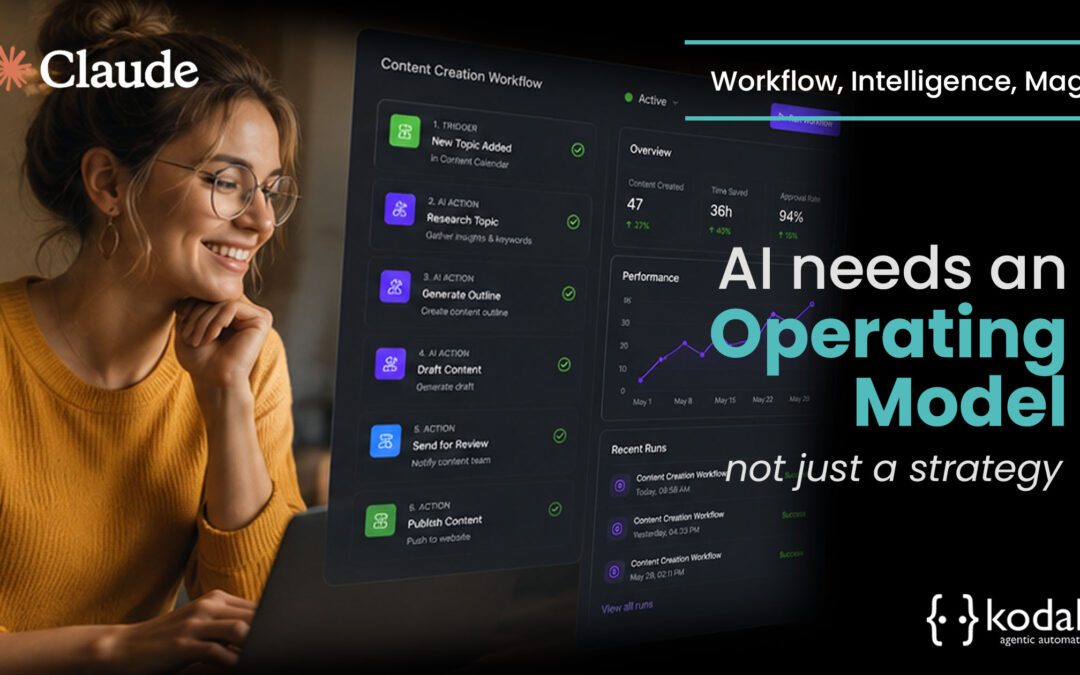
Operational AI only works when it runs on a clear operating model.
Without defined workflows, ownership and outcomes, AI does not magically create efficiency. It usually amplifies what is already there: unclear processes, disconnected systems and teams trying to solve the same problems in different ways.
For COOs exploring how to bring AI into everyday operations, the operating model is what separates interesting experiments from repeatable business impact.
AI is arriving faster than operations can absorb it
AI has moved quickly from future trend to immediate pressure.
Boards want progress. Vendors are promising transformation. Teams are quietly testing tools wherever they can find a use case.
The challenge is not a lack of AI options.
The challenge is that most organisations are trying to introduce AI into workflows that were never designed for it.
The result is familiar:
- Pilots that look impressive in a presentation but struggle when they meet real operational complexity.
- Teams working around official processes because AI tools do not reflect how work actually happens.
- Growing risk as unofficial AI usage spreads without clear ownership or governance.
A sales manager uses one AI tool to summarise customer conversations. A finance team uses another to automate reporting. An operations team experiments with a third.
Individually, these activities might be useful.
Together, they create another layer of complexity.
The underlying issue is simple: AI is being asked to improve work before organisations have clearly defined how that work should happen.
AI is not the transformation. The operating model is.
Many organisations approach AI as if the technology itself is the transformation.
The thinking is understandable:
“We will introduce enough AI tools, and the business will naturally become more intelligent.”
The problem is that technology cannot decide how your organisation should operate.
Your operating model defines how work moves across people, processes and systems. It determines who owns decisions, where information lives and how outcomes are measured.
AI simply becomes another capability inside that model.
A more practical way to think about it:
- Strategy defines where the business wants to go.
- The operating model defines how the business gets there.
- Operational AI improves specific parts of that journey.
Without that middle layer, AI becomes a collection of disconnected experiments. Each tool has its own logic, data and risks.
With a clear model, AI becomes part of how the business runs.
Three common myths about AI operating models
“Our CRM is our operating model”
Your CRM is an important system, but it is still only one part of the bigger picture.
Salesforce can manage customer data, opportunities and revenue processes. It does not define how sales, delivery, finance and operations work together.
“One platform will solve everything”
Platforms are powerful, but they do not create ownership, governance or cross functional alignment.
A tool can support a process. It cannot design the process for you.
“An AI centre of excellence means we are ready”
A centre of excellence can create standards and direction.
But operational AI succeeds when everyday teams know how work should flow, where AI fits and who is accountable when decisions need human input.
The Kodah lens: Workflow, Intelligence, Magic
Kodah uses a simple sequence to help organisations approach AI in the right order:
Workflow.
Intelligence.
Magic.
The order matters.
Most organisations want to start with the magic. They want autonomous agents completing tasks, making decisions and removing manual work.
That is understandable.
It is also where many AI projects go wrong.
Workflow: make the process work first
The first step is understanding how work actually happens today.
Not how the process document says it happens.
Not how leadership assumes it happens.
How it really happens.
Start by asking:
- Who owns each step when something goes wrong?
- What information does someone need before they can make a decision?
- How do we know the process has been completed correctly?
The goal is a repeatable workflow that works before AI enters the picture.
If humans cannot reliably follow the process, agents will not magically improve it.
They will just automate the confusion.
Intelligence: add reasoning where decisions happen
Once the workflow is stable, intelligence can be layered on top.
This is where tools like Anthropic Claude become valuable.
The goal is not immediate autonomy.
The goal is better decisions.
Claude can help teams interpret information, identify risks, summarise complex inputs and recommend next actions.
For example:
A large deal is moving from sales into delivery. Instead of someone manually reviewing dozens of CRM fields, email threads and meeting notes, Claude can highlight missing information, summarise the customer context and flag potential delivery risks.
Or an operations team receives hundreds of support requests each week. Claude can identify patterns, group related issues and help the team focus on the problems creating the biggest impact.
People remain responsible for decisions.
They simply have better information.
Magic: automate with control
Only after the workflow and intelligence layers are working should organisations introduce autonomous agents.
This is where AI starts taking action.
But successful automation is not about removing humans from the process.
It is about removing unnecessary repetition.
Agents can create tasks, update systems, trigger workflows and handle clearly defined actions.
But they need guardrails.
That means clear rules, audit trails, ownership and a way to pause the system when something changes.
The magic is not the technology.
The magic is having a process reliable enough that automation can safely run inside it.
A practical example: moving from sales to operations
Consider a common operational challenge.
Sales closes a new customer deal.
Now operations needs to deliver.
The information exists, but it is scattered.
The opportunity is in Salesforce.
Project delivery happens in ClickUp.
Important context is sitting across emails, documents and conversations.
Someone suggests adding AI.
The first instinct is usually to add another assistant or automate a few tasks.
The problem is that the underlying handoff is still broken.
Using Workflow, Intelligence, Magic creates a different approach.
Workflow
The team defines the path from Closed Won opportunity in Salesforce to a ready to execute project in ClickUp.
They agree:
- Who owns each handoff.
- What information is required.
- What “ready for delivery” actually means.
Now there is a process worth improving.
Intelligence
Claude becomes the reasoning layer.
When Salesforce records a Closed Won opportunity:
- Claude reviews the opportunity details.
- Checks whether required information is complete.
- Summarises the customer requirements.
- Highlights risks before delivery begins.
Operations receives a clearer picture without manually piecing everything together.
Magic
Once the workflow is proven, an agent can take action.
It can:
- Create the ClickUp project using the correct template.
- Assign tasks and owners.
- Set deadlines based on agreed rules.
- Update Salesforce and internal systems with progress.
If something looks unusual, the team can pause the process, correct the issue and continue.
The automation supports the operating model. It does not replace it.
The same thinking applies elsewhere:
A finance team could use AI to monitor approval delays and highlight where decisions are stuck.
A customer support team could use AI to group recurring issues into improvement projects instead of handling the same problems repeatedly.
The pattern stays the same: fix the workflow first, then add intelligence.
Prioritisation: where should COOs start?
AI transformation cannot happen everywhere at once.
Most COOs have limited capacity for change, competing priorities and teams already managing full workloads.
The question is not:
“Where can we add AI?”
The better question is:
“Which workflow would create the biggest operational improvement if we fixed it?”
A strong starting point usually has three characteristics:
- It creates visible friction for teams or customers.
- It involves multiple systems or departments.
- It has a clear business owner who can drive change.
A broken sales handoff may be a better first project than an internal chatbot nobody urgently needs.
Prioritisation matters because successful AI adoption creates momentum. The first win should prove value, not create another experiment.
A practical 90 day path
Month one: understand reality
- Map one important workflow from beginning to end.
- Identify ownership gaps, bottlenecks and unnecessary manual work.
- Assess whether your people, processes and systems are ready.
Month two: stabilise the workflow
- Redesign the process around how work should move.
- Clarify ownership and decision points.
- Align tools like Salesforce, ClickUp and other systems around the improved process.
Month three: introduce intelligence and automation
- Add Claude or similar AI capabilities to improve analysis, validation and routing.
- Start with one clearly defined automated action.
- Build governance around what the agent can and cannot do.
The goal is not to launch more AI projects.
The goal is to create a business that knows how to use AI well.
See what an AI operating model could look like in practice
If you want to explore how Workflow, Intelligence, Magic applies to your organisation, join the Masterclass.
We will walk through real operational examples, discuss where AI creates value and help you identify the first workflows worth transforming.
The starting point is not another tool.
It is understanding how your business works today, and where AI can genuinely make it better.