
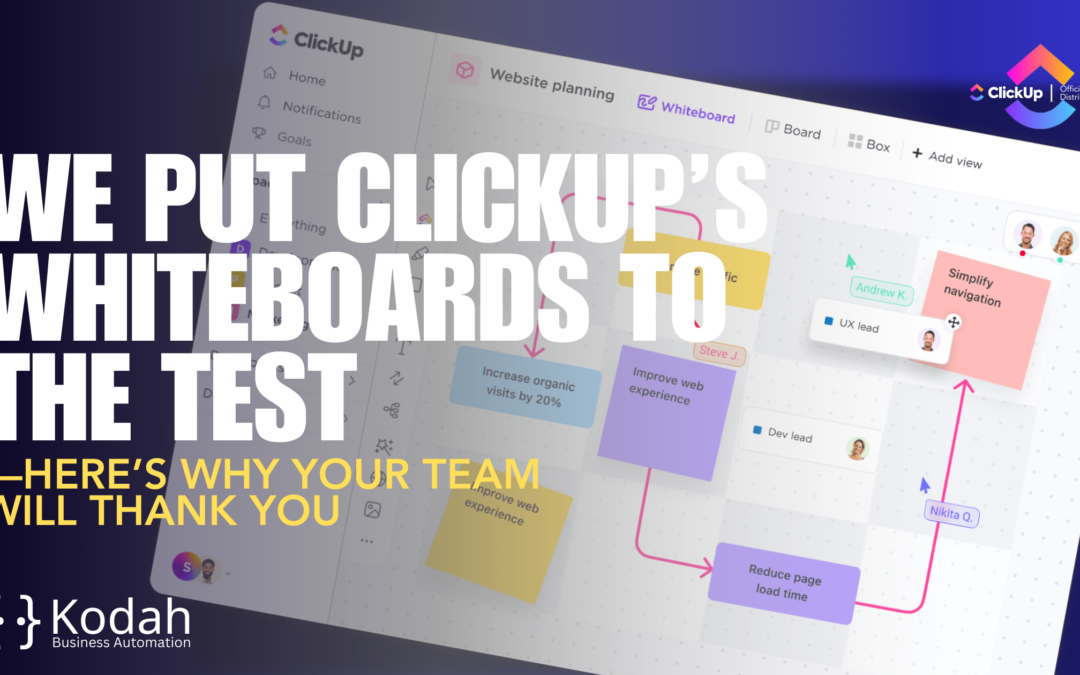
At Kodah, we are strong believers in automation. That said, not every problem needs another dashboard or timeline. Sometimes, what a team really needs is a shared space to think. That idea led us to test ClickUp Whiteboards. The promise was simple: reduce the gap between ideation and execution. The result exceeded expectations. Below is how Whiteboards worked in practice and why they quickly became part of our workflow.
1. From brainstorming to action, without friction
Most brainstorming sessions end with screenshots and a vague promise to turn ideas into tasks later. ClickUp Whiteboards remove that extra step entirely.
We brainstormed using sticky notes, mapped ideas visually, and converted those notes into tasks on the spot. Tasks were linked to ClickUp lists and assigned to owners in real time. Moving from “what if” to “what’s next” felt natural, and momentum was maintained rather than lost.
2. Visual project mapping that actually drives delivery
Complex projects benefit from being seen, not just listed. We used Whiteboards to create flow diagrams that showed dependencies, bottlenecks, and timing at a glance.
Because task cards are clickable and fully functional, the board was not just a visual aid. It became an active project management tool. Whiteboards combine the freedom of a sketchpad with the structure of a project hub.
3. Cross-functional collaboration that feels human
Whether your team works in one office or across multiple time zones, Whiteboards create a shared experience that feels intuitive and inclusive.
Everyone can contribute visually, which reduces long comment threads and unnecessary email chains. We found this especially useful during sprint planning and campaign ideation. Different departmental perspectives were visible immediately, making alignment faster and more natural.
4. A smoother handoff between teams
Once projects moved out of ideation and into execution, Whiteboards continued to add value. Designers linked mockups directly to tasks, marketers tagged deliverables, and developers could clearly see how their work fit into the broader plan.
Context stayed intact throughout the handoff process. There was no need for re-explanation or translation. Collaboration remained continuous.
Why your team will thank you
Whiteboards shorten meetings, clarify ideas, and accelerate collaboration. They do more than capture creativity. They actively support it.
At Kodah, we are always testing tools that combine automation with human instinct. ClickUp Whiteboards are a strong example of this balance. They turn collaboration from a task into a source of energy and motivation.
If your team works equally in lists and ideas, Whiteboards are well worth trying. Your next breakthrough might already be waiting on a blank canvas.