
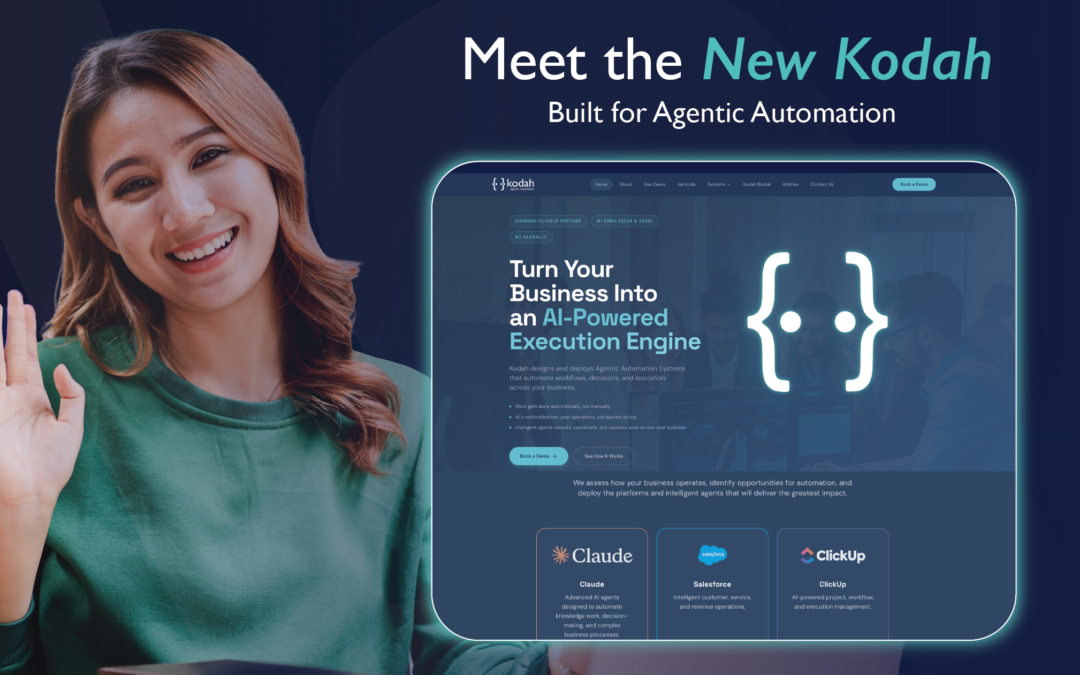
The new Kodah website is live.
It reflects something that has been at the heart of our work for a long time.
Businesses do not need more disconnected tools, more AI experiments or more technology for the sake of it.
They need work to move faster.
They need less manual effort.
They need clearer ownership.
They need more reliable execution across customer, revenue and operational journeys.
That is what matters most. And that is what Kodah is built to deliver.
Agentic Automation built around outcomes
Kodah is an Agentic Automation business.
We help organisations improve how work moves through customer, revenue and operational journeys.
We start with the workflow, not the technology.
Where does work slow down? Where does information get lost? Where are people spending time chasing, checking and coordinating? Where are customers waiting? Where are teams relying on spreadsheets, inboxes, chat messages or manual follow up to keep work moving?
Then we define the outcome that needs to improve.
That could mean:
- Reducing the time it takes to turn a signed deal into customer value
- Removing manual effort from a high volume operational process
- Improving how opportunities move through a revenue workflow
- Reducing dropped handoffs between teams
- Giving leaders earlier visibility into delivery risk
- Improving customer response and resolution times
- Creating more capacity without simply adding more people
- Giving teams a more consistent way to execute repeatable work
Only then do we determine the right technology and solution for that environment.
The approach is straightforward.
Understand the workflow
Define the outcome
Choose the right technology
That technology could be ClickUp, Salesforce, Claude, Agentforce, another partner technology or a combination of capabilities where the use case genuinely requires it.
The technology matters.
It just comes third.
The point is to make the business work better.
Beyond AI experimentation
Most organisations have already experimented with AI.
There may be a chatbot answering internal questions, a pilot summarising information, an automation creating tasks or an AI feature suggesting what someone should do next.
Those experiments can be useful.
But a useful demonstration is not the same as a business capability.
The harder questions start after the demo.
Does it fit into the real workflow?
Will people actually use it?
Does it reduce manual effort or create another thing for someone to manage?
Who owns the workflow and the outcome?
What happens when information is incomplete?
What happens when an exception needs human judgement?
Does it work consistently across the systems and teams involved?
Most importantly, what gets better because it exists?
Kodah helps organisations move beyond isolated AI activity and towards Agentic Automation that supports real work.
For some organisations, that will include Production AI. That means AI capabilities embedded into everyday workflows, connected to business systems and designed with accountability, adoption and ongoing operation in mind.
For others, the right starting point may be workflow mapping, process design, data clean up or simply making better use of technology already in place.
There is no standard starting point.
The business need comes first.
Workflow before Intelligence
One principle sits at the centre of the new Kodah website:
Workflow before Intelligence.
Before introducing an agent, AI capability or automation, we need to understand how the work actually happens.
That means starting with a business journey rather than a product category.
It could be:
- Lead to value
- Closed Won to first value
- Customer question to resolved outcome
- Incident to resolution
- Renewal to expansion
- Internal request to approval
- Quote to cash
- Brief to completed delivery
For each journey, we ask practical questions.
What is happening now?
We map the real workflow with the people who actually carry it.
Where does the work begin?
Where does it wait?
Where is information lost?
Which steps happen in email, chat or spreadsheets because the existing process does not properly support the work?
Where do people manually check, chase or reconstruct context before they can take the next step?
What is the friction costing?
The problem needs to be more specific than, “We should use AI.”
It could be a slower sales cycle, delayed customer onboarding, missed follow up or high cost per transaction.
It could also be less obvious.
A delivery leader might spend an hour every morning chasing project status across different teams. A customer success team might spend half its day looking through old emails to understand what was promised. Neither problem sounds particularly dramatic on its own.
Multiply that across a business and it starts to matter.
Other examples include:
- Rework caused by incomplete information
- Lower customer satisfaction
- Poor adoption of a new process
- Too much leadership time spent chasing status
- Unclear ownership between teams
- Customer facing teams spending too much time on administration
The clearer the operational problem, the easier it is to design something that makes a meaningful difference.
What should improve?
The next step is to define the practical outcome the organisation wants to create.
That may be:
- Faster customer onboarding
- Better handoffs between sales and delivery
- Reduced manual coordination
- More reliable pipeline follow up
- Fewer errors and less rework
- Better visibility for leaders
- Faster responses to customer requests
- More consistent execution across teams
- More capacity for higher value work
Instead of asking, “Where can we use AI?”, organisations can ask:
“What needs to improve, and what is the best way to make that happen?”
That is a much more useful place to start.
Agentic Automation built around the work
Agentic Automation is not about placing an AI assistant on top of every system.
It is about designing workflows where intelligent capabilities can observe what is happening, interpret context and support the next appropriate action.
Sometimes the answer is a redesigned ClickUp execution system with clearer ownership, stronger templates and more reliable workflows.
Sometimes it is a Salesforce improvement that makes commercial stages more meaningful, customer information easier to use and handoffs more consistent.
Sometimes Claude or Agentforce can help a team interpret information, identify missing context or prepare a recommended next step.
Sometimes the answer is a straightforward integration, cleaner data or a clearer process rule.
And sometimes the right answer is to pause before introducing AI because the workflow itself needs to be understood or stabilised first.
That is what a technology agnostic approach looks like in practice.
The technology serves the workflow.
The workflow serves the outcome.
A practical example
Take the journey from signed deal to first customer value.
A business may find that customers are waiting too long after signing because internal teams are manually coordinating what happens next.
Perhaps sales information is incomplete or difficult for delivery to find.
Perhaps the delivery team is unclear about what was actually promised.
Perhaps project set up varies depending on who creates it.
Perhaps key stakeholders are not identified early enough.
Or perhaps the customer is asked to repeat information they have already provided.
The result is familiar. Tasks get missed, handoffs slow down and leaders only discover the problem when the customer starts asking questions.
The right solution might involve a stronger Salesforce workflow, a ClickUp onboarding system, a Claude powered handover assistant, a new approval step or a combination of improvements.
Kodah does not begin by deciding which one to sell.
We begin by asking what needs to change.
The desired outcome might be a smoother transition from sales to delivery, less manual handover work, faster activation and a more consistent customer experience.
That is where Agentic Automation becomes commercially useful.
The role of adoption
An incredible system that nobody uses has no value.
Technology is only one part of transformation. The harder work is helping people trust, understand and adopt a new way of working.
That means adoption cannot be treated as something to consider at the end of a project.
It needs to be designed into the solution from the beginning.
A strong implementation considers:
- The people who will use the workflow every day
- Who owns decisions, exceptions and handoffs
- The information people need to do their work confidently
- The training and support required for adoption
- The behaviours that need to change
- The feedback loops that help teams improve the system over time
The goal is not to introduce technology and hope people adapt.
The goal is to create a better operating model that people can actually use with confidence.
The right solution for your environment
Kodah works across an ecosystem of technologies and capabilities, including ClickUp, Salesforce, Claude, Agentforce and other partner technologies.
We do that because businesses are different.
They have different operating models, data maturity, customer journeys, systems, risks and ambitions.
One organisation may need to make its existing work platform more effective.
Another may need a CRM or RevOps redesign.
Another may need workflow mapping before choosing any technology.
Another may be ready to introduce controlled agentic workflows around a high value operational process.
Our job is to understand the environment before recommending the solution.
That is a more disciplined approach.
And it is worth it.
Technology decisions made before the workflow and outcome are clear can create more complexity, more cost and more work for the people they were meant to help.
Explore the new Kodah website
The new Kodah website is a clearer home for the work we do and the conversations we want to have.
You can explore:
- Agentic Automation and Agentic Execution Systems
- Workflow mapping and operational design
- AI operating models and AI readiness
- ClickUp execution systems
- Salesforce and RevOps solutions
- Claude, Agentforce and other AI capabilities
- Production readiness for AI initiatives
- Discovery sessions and executive masterclasses
- Partnership opportunities for agencies, consultancies and technology partners
If you have a workflow that is slowing down, a customer journey creating unnecessary friction or an AI initiative that has not yet become part of day to day operations, start there.
Look at the work first.
Work out what needs to improve.
Then decide what technology can actually help.
Welcome to the new Kodah.
Welcome to a smarter way to execute.